NegotiateValue.AI: I built an AI negotiation trainer on the Harvard 7 Elements framework, with INSEAD methodology behind it
Most professionals run hundreds of negotiations and train for none
Negotiation is one of the highest-leverage skills in business and almost nobody practices it. 56% of US workers accept the first salary offer. One negotiation lifts compensation by roughly 7% on average, and that compounds into hundreds of thousands over a career. Meanwhile the only real way to practice is to find another human, book time, and role-play.
I sat in the INSEAD negotiation course and saw the constraint clearly. The framework was not the bottleneck. The practice partner was. So I built one that is always available, always in character, and always scoring the conversation.
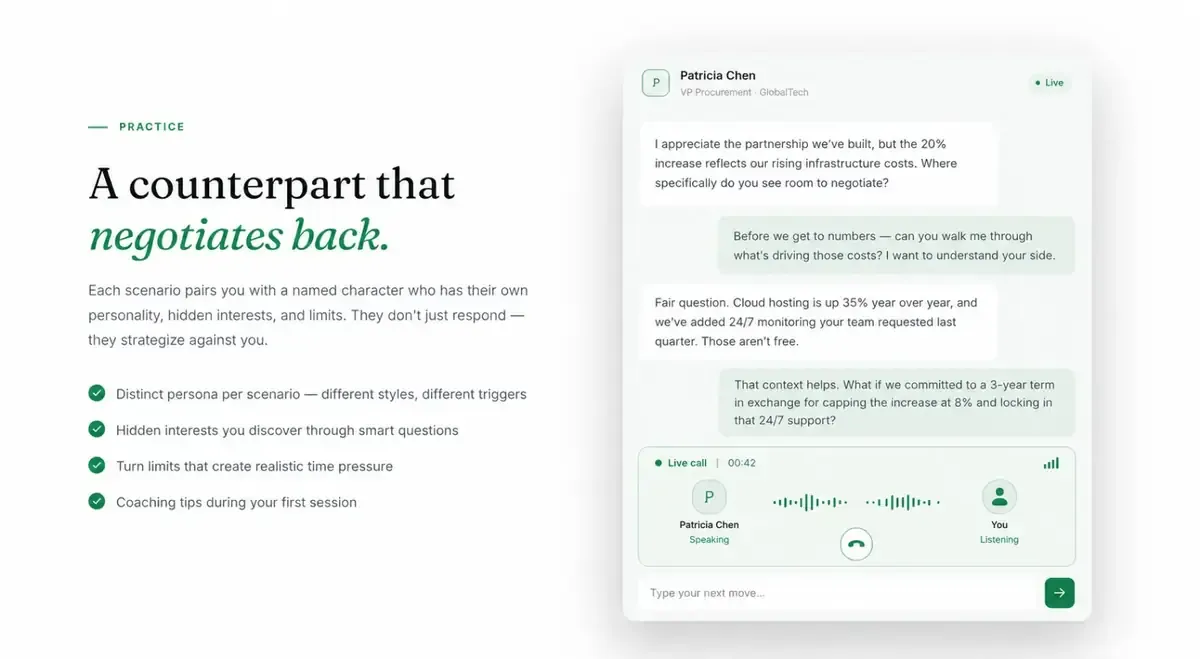
The hard part is not generating dialogue. It is a counterpart with hidden interests that pushes back credibly, plus feedback specific enough to change behaviour instead of handing out generic praise.
Three steps, seven minutes, one sharper negotiator
Every session follows the same loop, and each stage is handled by a separate agent with a distinct contract. One model doing all three jobs slips out of role the moment it starts coaching.
Scenarios cover salary talks, vendor contracts and partnership terms. Turn limits create real time pressure. The counterpart rewards good diagnostic questions and punishes weak concessions, which is what makes the score mean something.
Five dimensions instead of a single vague verdict
An L&D surface for the person accountable for capability
Individual practice sells itself, but the buyer inside a company is the L&D or procurement lead who has to prove capability moved. So I built an admin surface for them: a cohort heatmap showing every dimension gap at a glance, a weekly nudge queue for who is falling behind, custom scenario authoring on their real supplier and deal context, and an auto-generated quarterly report they can take into a CPO review.
Pricing follows the same logic. Free covers one baseline scenario so the method is easy to try, Pro at $49/month opens the full library, longer sessions and moment-level feedback, and a custom tier handles large teams with SSO, DPA and security review.